
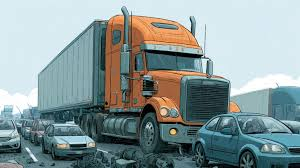
Why Longer Stopping Distances Increase Crash Severity
Commercial trucks are a necessity for transporting goods, especially for long distances. These large trucks and tractor-trailers ship goods across the country each day. However, they can potentially be dangerous and cause devastating damage to smaller vehicles on the highway. Statistics from the National Highway Traffic Safety Administration indicate that more than 70 percent of the fatalities involving large trucks are individuals in other vehicles.
Motorists driving on the highway close to these massive trucks should always be alert and use extreme caution. One of the most significant issues with large trucks is that, due to their size, many drivers don’t consider how long it takes them to stop, which can drastically increase the risk of accidents. It takes a commercial truck much more room to stop than cars, SUVs, or passenger trucks. Understanding how these accidents occur and staying safe on the highway is critical for every driver.
What is Stopping Distance?
Stopping distance is the time it takes a vehicle to come to a full stop. One of the most significant reasons large trucks take longer to stop is their weight. While the average car weighs approximately 3,000 pounds, a fully loaded commercial truck may weigh as much as 80,000 pounds, which affects the amount of brake power needed to stop. When traffic patterns change, sudden braking may be necessary. When the road is slippery, it extends the stopping distance for commercial trucks. Drivers should use extreme caution in foggy, rainy, or snowy conditions.
A scientific explanation for a truck or other object to stop involves distance, force, and time. An object like a large truck stays in motion until a force, like applying the brakes, stops it. However, the truck can’t immediately come to a stop when the driver hits the brakes. A truck’s acceleration depends on its mass and the amount of force that’s applied. To put it simply, a large commercial truck that’s fully loaded needs much more space to stop than passenger vehicles and smaller trucks.
The stopping distance for commercial trucks increases the dangers for all drivers. One of the biggest risks is rear-end collisions. These accidents may occur if a car cuts in front of a truck quickly, not allowing the driver time to stop. In a serious braking situation, the trailer on a commercial truck may skid and lock up. If the trailer jackknifes, it could block several lanes and cause a multiple-vehicle accident. Truck drivers can help to prevent serious accidents by maintaining safe distances from other vehicles and learning about stopping distances.
The Most Common Issues With Stopping Distances
The speed at which a truck is traveling may impact other drivers. A good example is a large truck traveling at 30 miles per hour. The driver needs at least 100 feet to stop. The faster a vehicle travels, the more time it takes to stop and prevent an accident. When a vehicle is traveling at 60 miles per hour, it requires at least 425 feet. Another issue with commercial trucks is road conditions. When a road is dry, a truck takes approximately 100 feet to stop. When there’s less traction due to slick, icy, or wet roads, a truck may need more than double the space. Conditions that may require more distance to stop include road construction or potholes.
Reaction time also plays a role in how much distance a truck needs to stop. When a driver has awareness of their surroundings, their reaction time is faster. However, driver fatigue, alcohol, or drug impairment can affect a driver’s reaction time and lead to devastating accidents. A driver’s experience and training can have an impact on
read more : https://billionfire.com/
whether they’re involved in an accident. A driver with extensive training and experience understands how to handle a commercial truck and its limitations. When a driver hasn’t had adequate training or isn’t an experienced driver, they aren’t prepared to handle unexpected situations on the road and might not react quickly enough to avoid a catastrophic accident.
Truck drivers who don’t understand how stopping distances work could be responsible for causing serious accidents. When a driver is in the path of a large truck that can’t stop quickly enough, it could cause devastating physical and emotional injury and financial hardship. Commercial companies usually have lawyers whose purpose is to protect the company’s assets. An employer could be held liable for not properly training drivers, negligent hiring or supervision practices, or not keeping their fleet of trucks properly maintained.
Steps To Take After an Accident With a Truck
It’s important to get medical assistance at the ER or from your doctor immediately following an accident. You should keep your medical records. Contact law enforcement to report the accident, even if the accident was minor and there were no serious injuries. Filing a police report is a necessity. The scene of the accident should be documented with videos or photos.
You should also get contact information from anyone who may have witnessed the incident. One of the reasons is that some companies will send people to clear the scene to prove their driver wasn’t at fault. Don’t discuss the incident with anyone at the scene, and don’t admit that you were at fault. A trucking company’s claims adjusters could use the information against you. It’s essential to get support from a truck accident attorney. An experienced lawyer will work to advise you of your rights and handle your claim.