
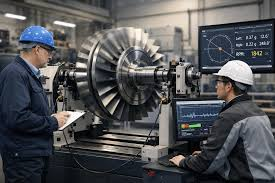
How Modern Workshops Balance High Power Output with Operator Ease of Use
The lack of qualified workers in manufacturing is not a problem for the future but rather a current issue. Equipment design is one of the only mechanisms that workshops can actually alter. The machines currently under construction are a physical manifestation of a complete reimagining: raw amperage is less important than how quickly an operator can use it efficiently.
The Shift Away From Brute-Force Machine Design
Heavy manufacturing used bulky, heavy, but reliable transformer-based welding power source for decades. As today’s heavy fabricators sought to deliver higher productivity and weld quality, using cleaner, more modern inverter-based power sources became a game-changer. These power sources are lighter, and more importantly, smaller – freeing up maximum floor space and ensuring that a single welding robot can connect to multiple power sources for automated welding operations. These power sources can also be wall-mounted, freeing up additional floor space.
Modular Setups and Where The Operator Actually Works
One of the more practical developments for heavy manufacturing environments is the wider adoption of separate wire feeders. Rather than placing the entire power source at the point of work, modular systems allow the power source to remain stationary while the wire feeder – and the torch lead – travels with the operator.
The wia weldmatic 500 is a good example of this approach in a high-output industrial context, combining substantial amperage capacity with a separate wire feeder that gives operators localized control without requiring the main unit to be moved or repositioned between jobs.
This setup has direct safety implications. Moving large power sources around an active workshop floor creates hazards – both from the physical handling and from trailing cables across high-traffic areas. Keeping the power source fixed while extending flexibility to the operator resolves both issues without sacrificing output.
Synergic Controls and The One-Knob Reality
Recently, the adoption of synergic control systems in MIG/MAG welding equipment alleviates one of the prominent cognitive burdens historically associated with the process. In a non-synergic setup, reaching optimum welding parameters – voltage and wire feed speed (WFS) – can be a time and resource-intensive process. This is due to the fact that at each higher current these values change. Given wire feed speeds are often stated in centimeters per minute, this necessitates recalculating the optimal WFS each time, which isn’t a problem when a computer is doing the math, literally, but adds a complication or two when relying on human brain power alone to juggle the task.
Synergic control enables a more automated and seamless alteration of these settings based on programmed knowledge of the best stable arc characteristics for the chosen material at the chosen thickness, which can be a hard target to aim for without the help of a control system. A background arc voltage and wire feed speed can be programmed for each potential metal transfer mode (short-circuiting, globular, spray, and pulse-spray), enabling precision beyond the reach of a human mind’s ability to hold and process variable data points for a multiple-curve graphical relationship.
read more : https://billionfire.com/
Duty Cycle and Production Continuity
The real measure of a machine’s worth is whether it can deliver the number of amps necessary for the weld. A machine might be able to provide peaks of ten or 20 more amps than required, but if the cycle time at that amperage is so limited that it forces the operator to move too quickly, the fit isn’t right. Likewise, a lightweight machine that provides the perfect amperage output but can’t handle the heat long enough to form a proper bead isn’t a good match.
Airflow and transformer design play a large role in the duty cycle and thermal capabilities of a machine. Large transformers with more surface area can handle more heat and provide more amperage. These machines are heavier and often bulkier, but they can be streamlined with more efficient design. More copper in the windings helps spread heat and maximize conductivity.
Arc Quality and The Hidden Cost Of Cleanup
The cleaning process after welding is often underestimated in production costs. Grinding spatter, reworking of rough welds, and re-inspection all cost time and money. This can be minimized with welding equipment that enables better arc stability at higher outputs.
Inductance control, which can be found on higher quality MIG machines, changes how the arc behaves at the point of short circuit. A higher inductance setting creates a softer arc that reduces spatter and produces a wider, flatter bead. A lower setting results in a more focused and intense arc which is beneficial for welding thin materials or for positional welding. If an operator has the option to set inductance, the welder can be adjusted for the specific requirements of the job rather than working with whatever is preset on the machine.
Digital volt and amp meters contribute to this in that they allow an operator or quality manager to check whether the weld parameters are within the tolerances specified in the welding procedure documentation. This is often neglected until quality issues or audits force the issue.