
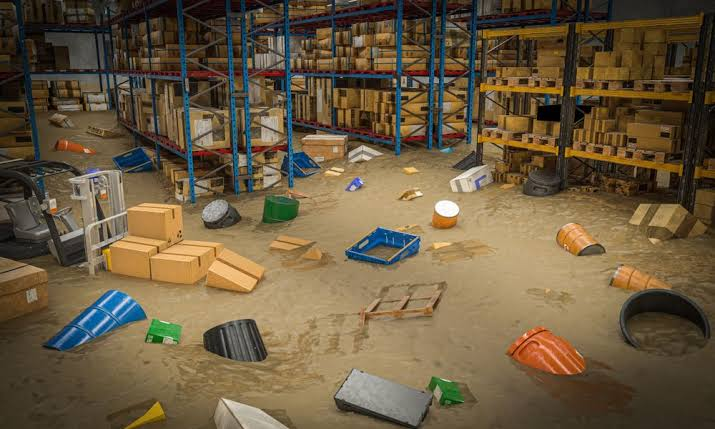
What Happens to Your Inventory When a Fire or Flood Hits Your Storage Unit or Stockroom?
Managing a large inventory can be a headache. Kept on-site, it takes up a lot of the available space and can feel a little like ‘putting all your eggs in one basket’, since any break-in or natural disaster risks wiping out your entire stock in one fell swoop. Then again, storing your inventory off-site is a risk, too; it’s not instantly available should you need it, but ensuring its security is out of your hands. True, most storage units are more secured against break-ins than the average storefront, but lots of other things can go wrong.
With that in mind, here are the differences between dealing with a fire or flood at your storage unit, vs your own stockroom.
Storage Units: Storage at Your Own Risk
A lot of people don’t realise that most storage units include a ‘Storage at Your Own Risk’ clause in their contracts, which basically absolves them of financial responsibility for your stock if it gets damaged to to fire, flood, mold, or smoke damage. As you can imagine, the fact that this was agreed to usually only comes to light in worst cas scenarios.
Usually, the storage unit’s liability only extends as far as their own fixtures, fittings and equipment. Anything you keep in there remains your responsibility.
Of course, this can vary, but in the majority of cases tenants are storing their stock at their own risk.
Under your agreement, you may be able to recover some money, but it’s unlikely to be anywhere near the full value of your inventory unless you have your own insurance coverage.
Once you’re cleared to enter the property safely, you’ll need to go in and document everything in as much detail as possible – the full extent of the damage, with photos, and of course the full value of everything lost. This can be a hugely disruptive process, even if you have further inventory stored elsewhere, since your attention is on clear-up rather than attending to the business’s day to day needs.
Stockrooms: Commercial Premises Insurance Offers Coverage for These Scenarios
A strong commercial property insurance policy will offer coverage for inventory that is damaged in your stockroom – say, by flood or fire – or stolen, as well as covering structural damage to the property itself.
This is why so many business owners prefer to manage inventory on-site. Not only do you have immediate, round-the-clock access to your stock, but you also have security control and more rights should something bad happen.
It’s also a lot easier to file a claim, since you’re working directly with your own insurance provider rather than liaising with the storage unit – who will, in most cases, have hundreds of other tenants in the same position as you if a flood or fire hits.
What’s more, commercial property insurance can also cover you against business income interruption. If your commercial property is hit by a natural disaster and you have structural issues or no ability to continue business as usual, you won’t be left totally out of pocket.
Again, you’ll want to make sure you carefully and clearly document everything in as much detail as possible. The only difference here is that you’ll be able to file a claim with your insurer using that proof, rather than being left in limbo wondering how much of your loss will be reimbursed – if any.