

How Automated Expense Tracking Is Shaping Modern Business
Key Takeaways
- Automated expense tracking eliminates tedious manual entry and reduces errors, ultimately saving finance teams significant time and effort.
- Real-time expense monitoring and alert systems help organizations quickly detect irregularities and respond to financial risks and fraud.
- Integrating expense management with broader financial systems allows for complete data visibility and cohesive reporting and analytics.
- Advanced AI-powered tools facilitate better compliance and adaptability as organizations grow and change.
In the evolving landscape of modern business, companies are continually searching for faster, smarter ways to manage their financial operations. With rising cost pressures and growing regulatory demands, organizations that adopt automated solutions are gaining a significant advantage. Automated expense management tools are at the forefront of this financial transformation, enabling businesses to streamline the capture, monitoring, and control of spending.
The adoption of these advanced systems is not just about keeping pace with competitors. Streamlined expense tracking delivers immediate benefits, including decreased manual workloads, improved accuracy, and real-time insights. As digital financial management becomes standard across industries, the role of automation in expense management is set to expand further, giving businesses robust tools to drive efficiency at scale.
Today’s business leaders recognize that more accurate, automated processes not only reduce operational risks but also unlock valuable insights. They can see spending patterns as they emerge, budget more effectively, and allocate resources more confidently, all of which are essential in fast-moving markets. For more on how automation can improve business efficiency, the Harvard Business Review highlights best practices for leveraging technology in expense processing.
Reducing Manual Data Entry and Errors
Manual expense processing is both time-consuming and error-prone. It involves collecting receipts, inputting data, and reconciling transactions by hand, all of which introduce the risk of human error and delays in reimbursement. Automated platforms dramatically simplify this process by using technologies such as Optical Character Recognition (OCR) to extract relevant details from receipts, invoices, and even emails. This reduces data entry requirements for employees and finance professionals, resulting in fewer mistakes and more reliable financial records.
Real-Time Monitoring and Alerts
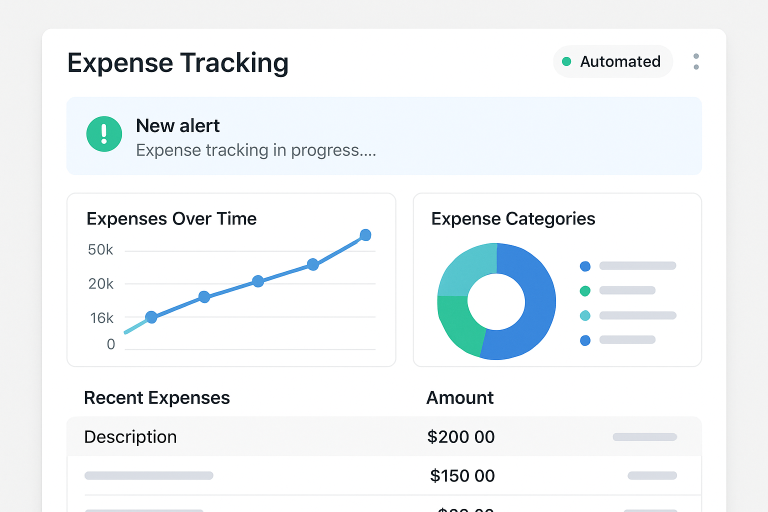
Businesses today can no longer afford to wait for month-end reports to gain insight into spending. Modern automated solutions enable real-time expense visibility, with dashboards that surface up-to-the-minute data on employee spending, departmental budgets, and compliance with company policies. These systems also feature proactive alerts that immediately flag spending that exceeds established thresholds or appears out of place. This allows companies to spot unusual patterns quickly and take corrective action before small discrepancies grow into costly problems.
Seamless Integration with Financial Systems
To maximize the impact of automated expense management, it must integrate with a company’s existing financial platforms, such as accounting and enterprise resource planning (ERP) systems. Integration ensures that data flows smoothly between various tools, eliminating silos and giving decision-makers a clear, consolidated view of financial information. Solutions that sync with platforms like QuickBooks, Xero, or Oracle NetSuite support comprehensive budgeting and analytics while reducing double-entry errors. According to TechTarget, tightly integrated systems yield significant time savings and improved accuracy across finance operations.
Enhancing Accuracy and Compliance with AI
Artificial Intelligence (AI) has transformed the field of expense management, making it easier than ever to categorize costs, identify anomalies, and ensure compliance with corporate policies. AI-powered expense systems review historical spending, learn from previous transactions, and automatically flag issues such as duplicate payments or out-of-policy expenses. They can also link receipts to payments and match them against purchase orders, creating audit-ready records and supporting regulatory compliance. As technology evolves, these systems continue to learn and adapt, delivering increasingly precise and effective results.
Improving Employee Experience
Automation benefits more than just finance teams. For employees, automated expense platforms take the complexity and frustration out of submitting expense reports, often enabling mobile submissions through photos or email integration. Faster, more accurate reimbursements boost employee satisfaction, while fewer administrative back-and-forths mean less time spent chasing approvals or correcting mistakes. This focus on ease of use contributes to a positive company culture and allows staff to spend more time on value-added work.
Cost Savings and Operational Efficiency
One of the most substantial advantages of automating expense tracking is the reduction in both direct and indirect costs. By eliminating the need for manual reviews and corrections, organizations free up staff time and reduce the costs tied to errors or compliance issues. Automated insights also improve financial oversight, enabling smarter budgeting, more precise forecasting, and greater transparency throughout the reimbursement process. As businesses scale, this operational efficiency provides a critical foundation for sustained growth and competitiveness.
Future Trends in Expense Management
The future of expense management lies in intelligence-driven tools that further automate and optimize the spend management lifecycle. Innovations like virtual cards, contactless payments, and zero-touch expense claims are reshaping how organizations purchase, track, and audit business spending. As machine learning capabilities mature, they will drive even greater accuracy and enable predictive recommendations for budget adjustments or cost-saving opportunities. Businesses that invest early in these advancements are positioned to outperform those tied to legacy manual systems.
Automated expense tracking is no longer a luxury but a necessity for companies seeking to modernize their financial operations. The shift not only alleviates the administrative burden but also delivers the strategic advantage of real-time insights and robust compliance. Organizations that embrace automation can expect improved accuracy, increased employee satisfaction, and more informed financial decision-making well into the future.