
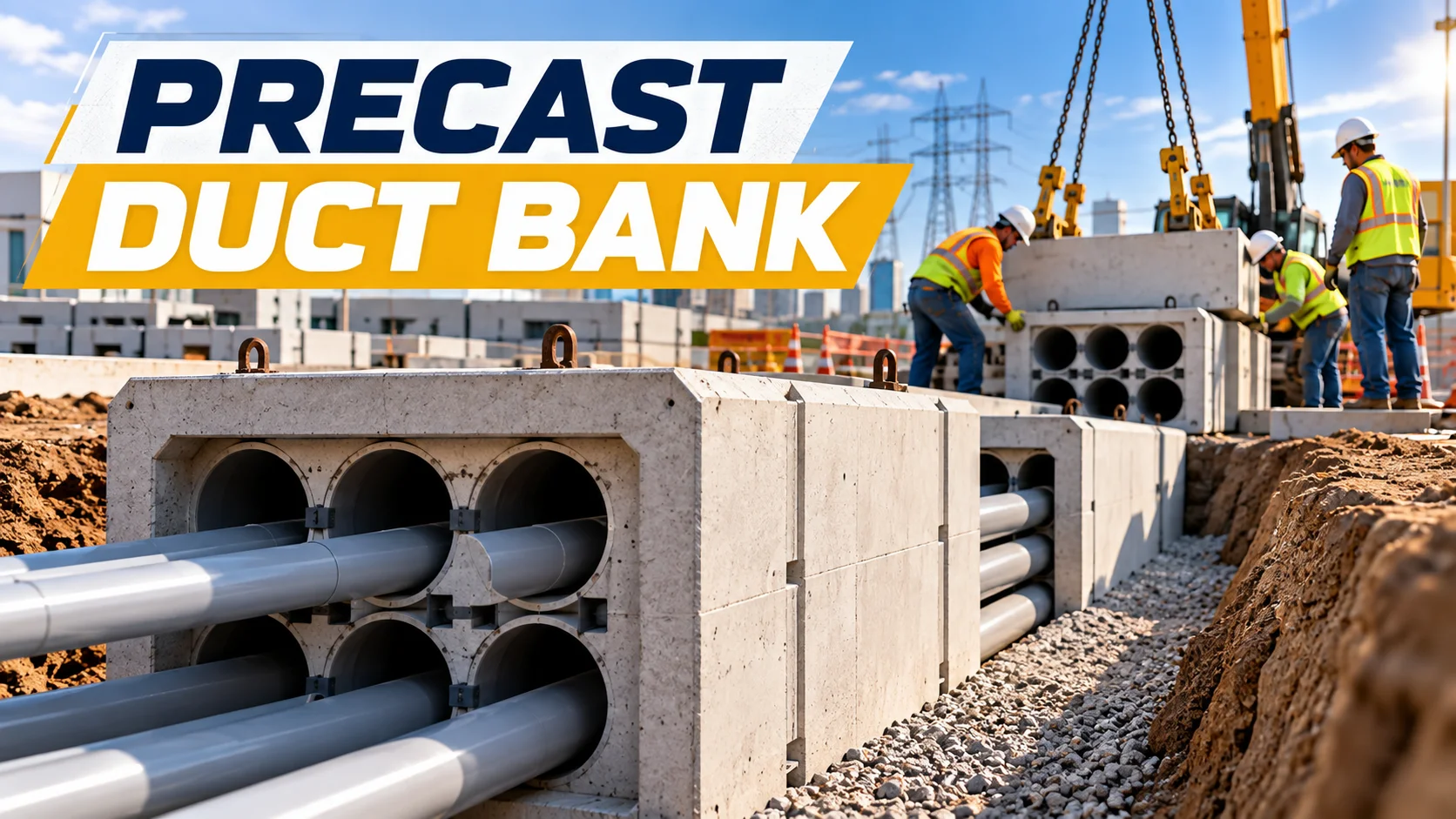
What Is A Precast Duct Bank?
A precast duct bank is a factory-made concrete structure containing multiple conduits for underground electrical or communication cables.
Instead of building the concrete enclosure around conduits at the construction site, manufacturers produce finished duct-bank sections in a controlled facility.
The sections are transported to the project, positioned in prepared trenches, connected, inspected, and backfilled.
Precast duct banks are used for electrical distribution, telecommunications, data centers, industrial facilities, substations, airports, hospitals, and large commercial developments.
How Does A Precast Duct Bank Work?
A precast duct bank creates protected underground pathways for cables and other utility systems.
Multiple conduits are arranged inside a concrete section according to the approved engineering design. Cables can later be pulled through these conduits without exposing them directly to surrounding soil.
What Is Inside A Precast Duct Bank?
The main components include concrete, conduits, joints, and any required reinforcement or lifting hardware.
PVC conduits are commonly used. ASTM C1903-24 specifically addresses precast concrete duct banks incorporating PVC duct within a concrete envelope.
The exact conduit size, number, spacing, concrete dimensions, and reinforcement depend on project requirements.
Why Are Multiple Conduits Used?
A duct bank can contain several conduits in one underground structure.
Some conduits may carry power circuits, while others can support communications, controls, fiber optics, or future expansion.
Separating circuits into individual conduits also makes cable installation and maintenance more manageable.
What Is ASTM C1903-24?
ASTM C1903-24 is the current ASTM specification for precast concrete duct banks.
The standard covers manufacturing, materials, concrete, conduit requirements, structural design, joints, installation, testing, inspection, and dimensional requirements.
It replaced ASTM C1903-21 and provides an important reference for projects specifying precast concrete duct banks.
What Concrete Strength Does ASTM C1903-24 Require?
ASTM C1903-24 specifies a minimum handling compressive strength of 2,000 psi, unless the design requires a higher value.
It also specifies a minimum compressive strength of 4,000 psi at delivery.
These requirements help ensure that sections can withstand handling, transportation, installation, and service conditions.
What Conduit Spacing Does The Standard Require?
ASTM C1903-24 specifies at least 3 inches between the concrete face and conduit outside diameter.
It also specifies at least 3 inches between the outside diameters of adjacent conduits, subject to applicable exceptions.
Spacing provides adequate concrete around the conduits and supports the structural requirements of the finished section.
How Is A Precast Duct Bank Installed?
Installation begins with excavation and preparation of the trench.
The construction team must prepare a stable foundation that meets the project’s elevation, compaction, and drainage requirements.
How Are Precast Sections Placed?
The completed sections are transported to the project site and positioned using suitable lifting equipment.
The trench must provide enough space for safe placement and proper alignment.
Crews then connect adjacent sections according to the approved joint design.
How Are The Sections Joined?
Precast duct-bank sections can use different joint arrangements.
ASTM C1903-24 addresses gasket and slip-joint approaches. The selected system must match the manufacturer’s instructions and project specifications.
Proper alignment is important because conduit connections must remain continuous through the entire duct-bank route.
What Happens After Installation?
After placement and inspection, the surrounding excavation is backfilled according to project requirements.
Backfill must be placed and compacted properly to provide the required support and protect the installed duct bank.
Final surface restoration depends on whether the duct bank is beneath pavement, landscaping, roads, parking areas, or another finished surface.
What Are Precast Duct Banks Used For?
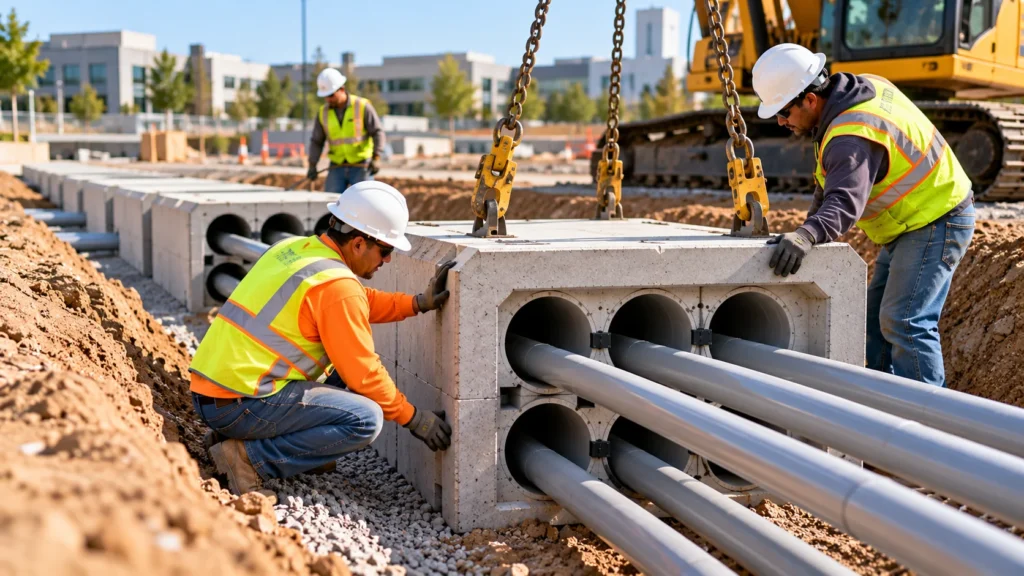
Precast duct banks are suitable for projects requiring protected underground cable routes.
Electrical Infrastructure
Electrical utilities use duct banks for feeders, distribution circuits, transformer connections, generators, substations, and other power systems.
Large facilities may require several parallel duct banks to distribute power across a site.
Data Centers
Data centers can require extensive underground electrical infrastructure.
Precast duct banks can provide repeatable conduit configurations between substations, generators, transformers, switchgear, and other electrical equipment.
Communications And Fiber
Duct banks can also contain conduits for telecommunications, fiber-optic systems, controls, and other low-voltage infrastructure.
The exact arrangement depends on the project’s electrical and communications design.
Industrial And Commercial Projects
Manufacturing facilities, hospitals, universities, airports, government sites, military facilities, and commercial developments can also use precast duct banks.
They are particularly useful where several underground utility pathways must follow defined routes.
What Are The Benefits Of Precast Duct Banks?
Precast construction moves much of the work from the job site to a controlled manufacturing facility.
Faster Field Installation
Finished sections can be installed after the trench is prepared.
The project does not need to build the complete concrete envelope around the conduits in the field.
This can reduce field construction time, although actual installation speed depends on site access, section size, lifting equipment, and crew conditions.
Controlled Manufacturing
Manufacturing allows conduit positions and concrete dimensions to be controlled before delivery.
Concrete testing and dimensional inspection can also occur before sections reach the project site.
Less Field Concrete Work
Traditional cast-in-place duct banks require conduit placement, spacers, reinforcement where required, formwork, concrete placement, and curing.
Precast sections eliminate much of this field work.
Reduced Open-Trench Time
Because the main duct-bank structure arrives already manufactured, the excavation can move toward placement and backfilling sooner.
This can be useful on projects where open trenches interfere with other construction activities.
What Are The Limitations Of Precast Duct Banks?
Precast systems also create planning requirements that should be considered before construction.
Transportation And Lifting
Concrete sections can be heavy.
Projects need suitable transportation routes, lifting equipment, staging areas, and sufficient access to the trench.
Limited Field Flexibility
Precast sections are manufactured according to approved designs.
Major changes after manufacturing can be more difficult than modifications to a cast-in-place system.
Cast-in-place construction may be more practical for routes with unusual geometry, frequent changes, or congested underground utilities.
Advance Engineering
Conduit locations and section dimensions need to be coordinated before production.
Changes involving cable quantities, conduit sizes, route geometry, or utility conflicts should therefore be addressed before manufacturing begins.
Precast Vs. Cast-In-Place Duct Bank
Both methods create protected underground conduit systems, but their construction processes differ.
| Factor | Precast Duct Bank | Cast-In-Place Duct Bank |
| Main construction | Factory manufactured | Built on site |
| Concrete work | Completed before delivery | Performed in the field |
| Installation | Lift and place | Assemble and pour |
| Curing | Completed before delivery | Required after concrete placement |
| Field flexibility | Lower | Higher |
| Heavy lifting | Required | Usually lower |
| Production control | Factory controlled | Site controlled |
The appropriate method depends on project design, schedule, access, utility congestion, equipment, and engineering requirements.
What Factors Affect Precast Duct Bank Cost?
There is no universal price for a precast duct bank.
The cost depends on section dimensions, concrete volume, conduit type, conduit quantity, reinforcement, joint design, transportation, lifting, excavation, backfill, and project location.
Longer sections can reduce the number of joints, but they may require larger lifting equipment and specialized transportation.
Projects should therefore compare the complete installed cost rather than only the manufacturing price.
For unrelated financial research, BillionFire also covers subjects such as a Berkshire Bank commercial loan application PDF, Farmers and Merchants Bank CD rates, and Lemont Bank & Trust.
What Quality Checks Are Required?
Quality control should cover both factory production and field installation.
Important checks can include concrete strength, section dimensions, conduit alignment, conduit condition, joints, lifting hardware, and visible surface defects.
Projects may also specify thermal resistivity testing for applications where cable heat dissipation is important.
ASTM C1903-24 references ASTM D5334 and IEEE 442 for thermal-resistivity testing when required by project specifications.
Does A Precast Duct Bank Need Reinforcement?
Not every precast duct bank requires conventional steel reinforcement.
ASTM C1903-24 allows the design to determine whether reinforcement is required. Structural loading, section dimensions, handling conditions, soil conditions, and project requirements can affect the design.
Some systems may use steel reinforcement or fiber reinforcement where engineering calculations require additional structural capacity.
Frequently Asked Questions
What Is A Precast Duct Bank?
A precast duct bank is a factory-produced concrete section containing conduits for underground electrical, communication, or control cables.
What Is The Difference Between Precast And Cast-In-Place Duct Banks?
Precast duct banks are manufactured before delivery and then installed in sections. Cast-in-place systems are assembled and concreted directly at the project site.
What Standard Covers Precast Concrete Duct Banks?
ASTM C1903-24 is the current ASTM specification addressing precast concrete duct banks and related manufacturing and installation requirements.
Are PVC Conduits Used In Precast Duct Banks?
Yes. ASTM C1903-24 specifically addresses precast duct banks incorporating PVC duct within a concrete envelope.
Where Are Precast Duct Banks Used?
They are used for underground electrical distribution, telecommunications, data centers, substations, industrial facilities, hospitals, airports, universities, and commercial developments.
Final Takeaways
A precast duct bank provides protected underground pathways by combining multiple conduits with a factory-produced concrete structure. It can reduce field concrete work and provide controlled conduit placement.
ASTM C1903-24 provides important requirements covering concrete strength, conduit spacing, structural loading, joints, testing, and installation. However, each project still requires engineering based on its specific loads, utilities, soil conditions, cable requirements, and site constraints.
Precast systems can work well when construction speed, repeatable designs, and controlled manufacturing are priorities. Cast-in-place construction may remain preferable where routes require extensive field adjustments or unusual configurations.