
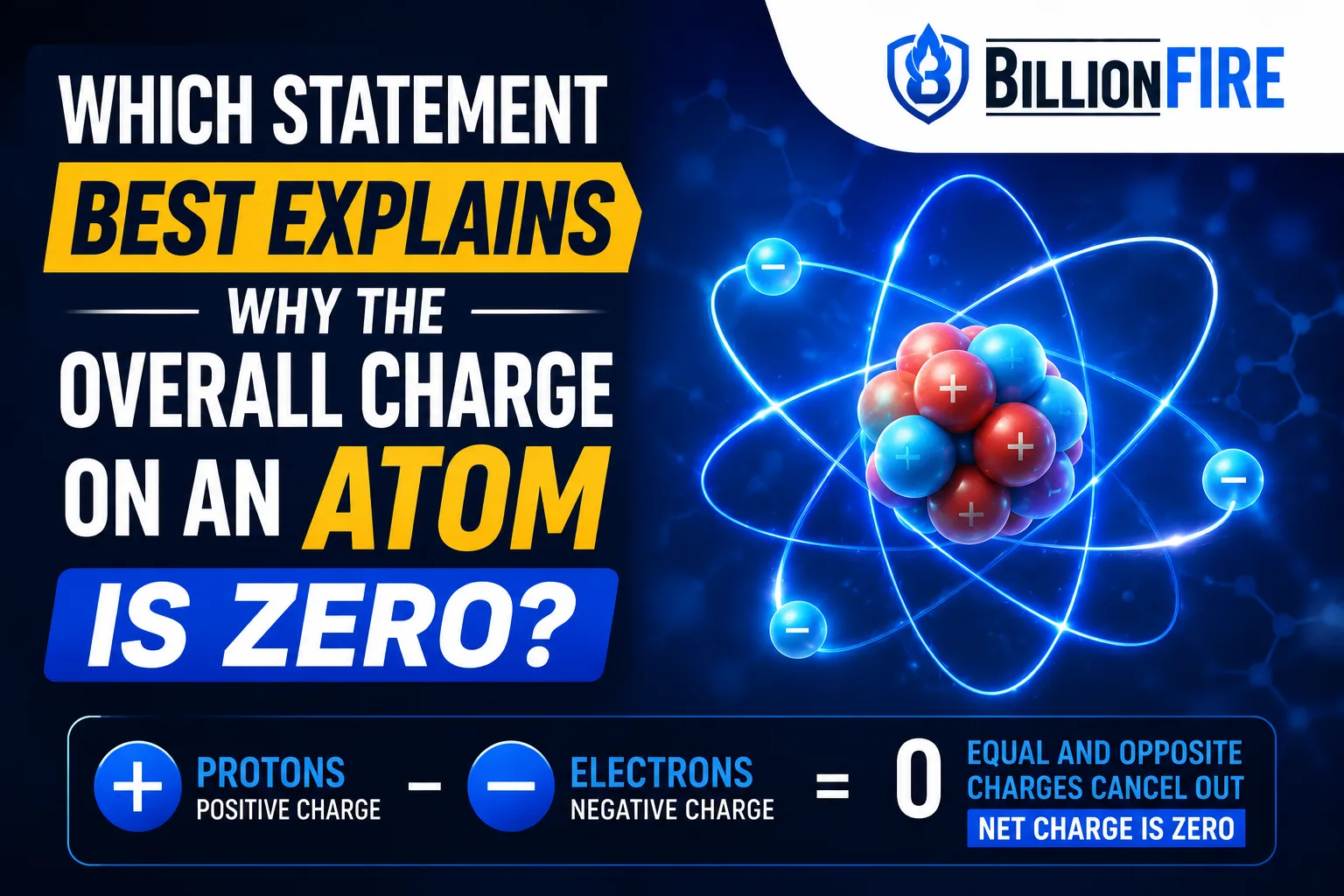
Which Statement Best Explains Why The Overall Charge On An Atom Is Zero?
Many chemistry students struggle with basic atomic theory. You might wonder which statement best explains why the overall charge on an atom is zero. The exact answer is quite simple. An atom has an equal number of positively charged protons and negatively charged electrons.
These opposite forces perfectly cancel each other out. This creates a state of perfect neutrality. Understanding this specific mathematical balance is the foundation of modern chemistry. We will explore exactly how these tiny particles interact to keep our physical universe stable.
Understanding The Basic Structure Of Matter
The Role Of Positively Charged Protons
Protons sit tightly packed inside the central nucleus of the atom. Each proton carries a positive electrical charge of exactly plus one. The total number of protons determines the exact identity of the element.
If you change the number of protons, you create an entirely different element. For example, every carbon atom in the universe has exactly six protons. If you add one more proton, it instantly becomes nitrogen. This proton count never changes during standard chemical reactions. The nucleus remains heavily guarded and perfectly secure at all times.
The Function Of Negatively Charged Electrons
Electrons are incredibly tiny particles compared to heavy protons. They carry a negative electrical charge of exactly minus one. These particles rapidly orbit the central nucleus in a wide region called the electron cloud.
They move at incredibly high speeds around the center. The negative energy of a single electron exactly matches the positive energy of a single proton. The distance between the nucleus and these electrons is mostly empty space. This vast empty space makes up the majority of the total atomic volume.
The Purpose Of Neutral Neutrons
Neutrons are the third primary building block of an atom. They sit inside the nucleus right next to the protons. However, neutrons do not carry any electrical charge at all.
Their main job is adding physical mass and stability to the central core. Without neutrons, the highly positive protons would repel each other rapidly. They would tear the delicate nucleus apart from the inside out. Neutrons act like a heavy glue to keep the entire structure securely fastened together.
The Exact Mathematical Balance Of Electric Charge

How Protons And Electrons Cancel Out
The mathematical rule for atomic charge is very straightforward. You simply add the positive and negative values together. A standard oxygen atom has exactly eight protons and eight electrons.
The math equation is plus eight combined with minus eight. The final result always equals absolute zero. This zero value means the particle is completely neutral. You will always find this exact zero balance in stable matter. It is a fundamental law of physics that governs all earthly materials.
The Importance Of The Atomic Number
You can easily find the atomic number of any element on the periodic table. This specific number tells you exactly how many protons exist inside the nucleus.
In a stable state, it also tells you the exact number of electrons. The atomic number is your key to understanding the mathematical balance quickly. A scientist can predict the behavior of an element just by reading this single number. It reveals the exact internal makeup of the chemical structure.
Why Perfect Neutrality Matters In Nature
If atoms were naturally charged, they would constantly repel or attract each other wildly. Our physical universe would be completely unstable. Neutrality allows solid matter to exist safely and predictably.
This zero balance lets atoms pack closely together in tight formations. They can safely form complex physical objects like liquid water, solid rocks, and human DNA. Without this perfect electrical balance, biological life could never exist on Earth. The universe relies heavily on this silent mathematical perfection.
Historical Discoveries In Atomic Theory
John Dalton And Early Atomic Models
Famous scientists built our modern understanding of matter over many centuries. John Dalton proposed the first scientific model of matter in the early 1800s.
He suggested that all physical objects are made of tiny particles that cannot be divided. His early work set the solid foundation for all future discoveries in modern chemistry. He proved that chemicals always combine in very predictable mathematical ratios. This discovery changed how the world viewed scientific research forever.
Ernest Rutherford And The Nucleus
Ernest Rutherford made a massive breakthrough in advanced atomic theory. He discovered that atoms are mostly composed of completely empty space. He also found a very dense central core, which he formally named the nucleus.
This discovery proved that positive mass is concentrated entirely in the center of the structure. The outer edges remain mostly empty and open. His famous gold foil experiment shocked the entire scientific community at the time.
Niels Bohr And The Electron Cloud
Niels Bohr expanded on previous scientific work by completely mapping the electron cloud. He proposed that negative particles orbit the center in very specific energy levels.
His visual model helps young students understand exactly how the negative and positive forces interact. We still use variations of the Bohr model in chemistry classrooms all over the world today. It perfectly visualizes the hidden mathematical balance of the universe.
When Atoms Lose Their Perfect Neutrality
The Process Of Chemical Ionization
Chemical reactions frequently break this perfect mathematical balance on purpose. Atoms naturally want to achieve maximum stability in their outer energy rings.
They often share, steal, or trade moving parts with other nearby atoms to reach this goal. This specific process is scientifically known as ionization. It is the main driving force behind all chemical bonding. When the zero balance breaks, matter becomes highly reactive and ready to change.
Forming Positively Charged Cations
An atom instantly becomes a reactive ion when it loses a negative electron. The remaining structure now has more positive protons than negative electrons. This creates a net positive charge overall.
Scientists call this specific type of positively charged particle a cation. Metals frequently form cations during standard chemical bonding processes. They eagerly give away their extra electrons to reach better internal stability.
Forming Negatively Charged Anions
Sometimes an atom gains an extra negative electron from a nearby chemical neighbor. The structure now holds more negative particles than positive ones. This creates a net negative charge overall.
Scientists call this negatively charged particle an anion. Nonmetals typically form anions during physical reactions. They aggressively steal electrons to complete their outer energy levels.
Applying Coulombs Law To Atomic Structure
How Opposite Forces Attract Each Other
Coulomb’s law explains exactly how electrical forces interact in raw nature. The basic rule states that opposites always attract each other. Positive protons and negative electrons pull toward each other very strongly.
This magnetic attraction keeps the tiny parts bound together tightly. The equal quantities ensure the entire structure remains completely neutral to outside observers. This internal tug of war never stops.
Preventing The Nucleus From Breaking Apart
Coulomb’s law also states that similar electrical charges repel each other strongly. The central core is packed tightly with positively charged protons.
These positive forces naturally want to push away from each other violently. The neutral neutrons act like a physical glue to keep the structure stable and secure. Without these neutral parts, the nucleus would instantly blow itself apart.
Managing Confusing Financial Charges In Daily Life
Tracking Unexpected Vehicle Travel Expenses
Understanding basic chemical charges is very different from managing your personal financial charges. Renting a car often leads to unexpected billing issues on your monthly bank statement.
You might find an unexpected erac toll charge on credit card document after a fun family vacation. This fee strictly covers unpaid highway tolls and daily administrative rental costs. Always review your final rental contract carefully to spot these hidden fees early.
Identifying Retail And Shared Laundry Bills
Other annoying mystery fees come from daily errands or busy apartment living. A csc service work charge on credit card statement usually means you paid for shared laundry machines.
A 702 sw 8th st charge on credit card document directly traces back to a physical purchase at the main Walmart headquarters. Ignoring any of these strange financial bills will eventually hurt your personal credit profile. Always track your spending carefully to maintain financial stability.
Frequently Asked Questions
What Is The Net Charge Of A Standard Atom?
The net charge is always exactly zero. The positive and negative electrical forces cancel each other out completely.
How Does An Atom Become Positively Charged?
It becomes positive if it loses a negative electron. This action leaves more positive protons than negative electrons inside the chemical structure.
Do Neutrons Affect The Electrical Balance?
No, neutrons do not carry any active electrical energy. They only add physical weight and solid stability to the central core.
Can Protons Leave The Nucleus?
Protons never leave the nucleus during standard chemical reactions. Only the outer electrons actively move around or transfer between different elements.
Why Is The Atom Mostly Empty Space?
The tiny electrons orbit very far away from the dense central nucleus. This wide orbit creates a massive void of completely empty space inside the physical structure.
Final Takeaways
The exact mathematical balance of tiny particles defines how our physical universe works safely. An atom always stays neutral because its positive protons and negative electrons match perfectly. This exact zero balance allows solid matter to exist safely without blowing apart. If you lose this specific electrical match, the particle immediately becomes a highly reactive ion. Neutrons never affect the electrical charge at any point. They only exist to keep the central nucleus completely stable and secure. Understanding this simple mathematical balance is the absolute foundation of all modern science.