
Bank Statement HELOC: Requirements, How It Works, And What To Know
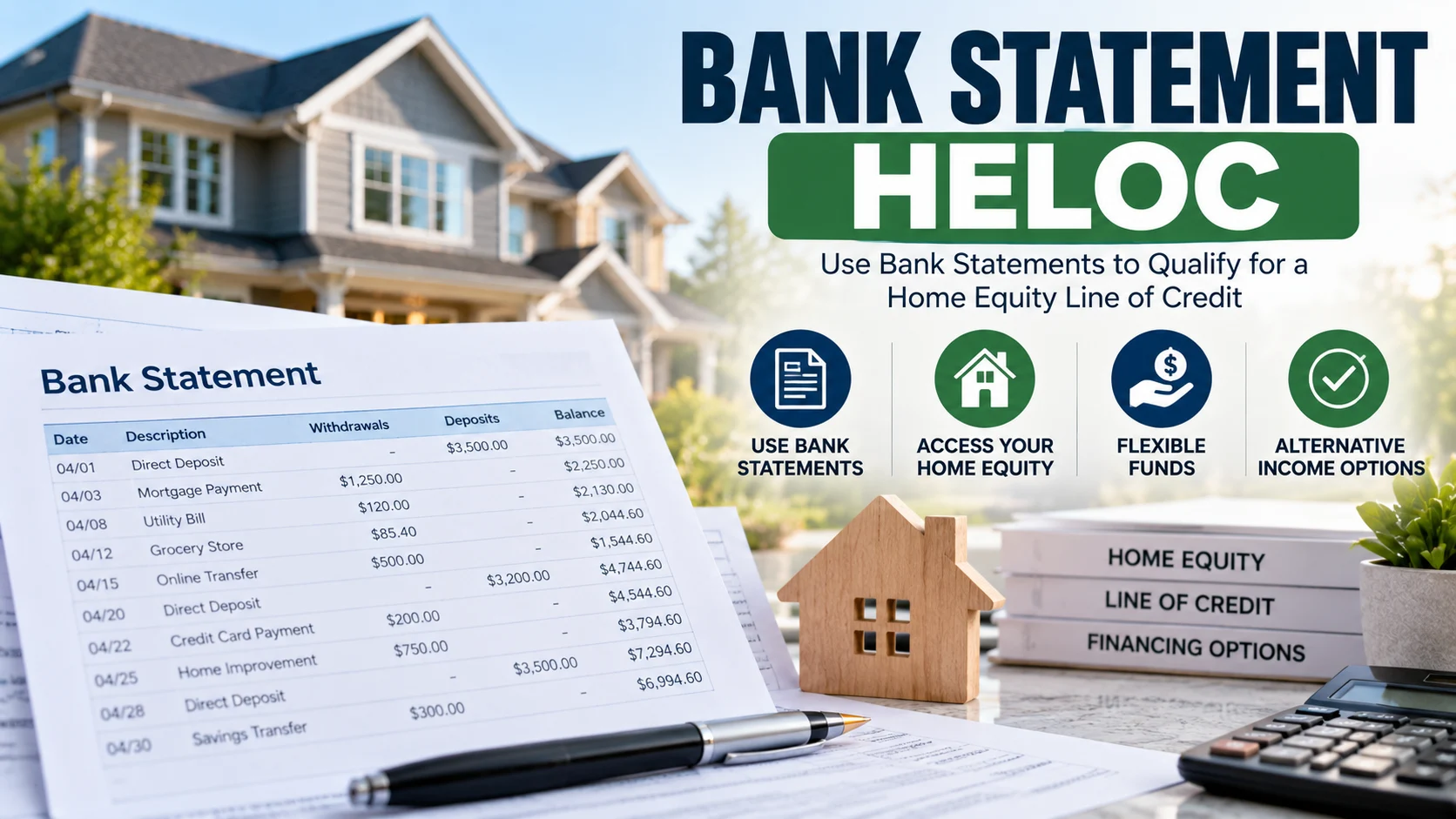
A bank statement HELOC is a home equity line of credit that uses bank deposits to evaluate income. It can help homeowners with nontraditional income qualify for financing.
These programs are often used by self-employed borrowers, business owners, freelancers, and independent contractors. Their tax returns may show less taxable income because of business deductions.
A bank statement HELOC does not eliminate underwriting requirements. Lenders can still review credit, home equity, property value, debts, deposits, and repayment ability.
What Is A Bank Statement HELOC?
A bank statement HELOC is a revolving credit line secured by a homeowner’s property. The lender uses bank statements to assess income instead of relying entirely on traditional income documents.
A standard HELOC can also require income verification. The difference is that a bank statement program focuses more heavily on documented deposits.
How A HELOC Works
A HELOC gives homeowners access to a predetermined credit limit. Borrowers can generally draw money during the draw period and repay the amount borrowed.
Interest usually applies to the outstanding balance rather than the unused credit limit. The exact payment structure depends on the lender and HELOC agreement.
The CFPB describes a HELOC as a revolving credit line secured by the borrower’s home.
How Bank Statements Change Qualification
Traditional mortgage underwriting often relies on pay stubs, W-2 forms, tax returns, or other income documents.
Bank statement programs instead examine deposits over a defined period. The lender then applies its income calculation method to determine qualifying monthly income.
This approach can help borrowers whose taxable income does not fully represent their business cash flow.
Who Uses A Bank Statement HELOC?
Bank statement HELOCs are primarily designed for homeowners with income that may be difficult to document through conventional methods.
Self-employed borrowers are one of the main groups using these programs. Business owners and independent contractors can also benefit when their income varies from month to month.
Self-Employed Borrowers
Self-employed borrowers can have substantial business revenue while reporting lower taxable income. Business expenses and deductions can reduce the income shown on tax returns.
A bank statement program can examine deposits instead of relying entirely on taxable income. This can provide another way to demonstrate repayment capacity.
However, lenders still need to determine which deposits represent usable income.
Business Owners And Freelancers
Business owners may receive payments from multiple clients throughout the year. Freelancers and contractors can also have irregular payment schedules.
Bank statements can show these deposits over time. The lender can then assess whether the cash flow appears sufficient and consistent.
The calculation varies between lenders, so borrowers should ask how deposits will be treated before applying.
How Many Bank Statements Are Needed For A HELOC?
There is no universal requirement for every bank statement HELOC.
Specialized programs commonly request 12 or 24 months of bank statements. Some lenders can have different documentation requirements based on the borrower and program.
12-Month Bank Statement Programs
A 12-month program examines deposits over the most recent year.
This can work well for borrowers with relatively stable recent business income. It can also reduce the period needed to document cash flow compared with a 24-month program.
The lender may still examine unusual deposits, transfers, and account activity during the review.
24-Month Bank Statement Programs
A 24-month program provides a longer view of the borrower’s financial activity.
This can be useful for businesses with seasonal income or changing monthly revenue. A longer history may also help show recurring cash flow.
The lender determines which deposits qualify under its underwriting rules.
What Do Lenders Look For On Bank Statements?
Bank statements provide more information than a simple monthly income figure.
Lenders can examine deposit patterns, recurring payments, transfers, large deposits, overdrafts, and other account activity.
Qualifying Deposits
The lender needs to identify deposits that represent actual income.
Transfers between the borrower’s own accounts may not count as new income. Loan proceeds and certain other deposits can also be excluded.
Therefore, total deposits do not necessarily equal qualifying income.
Large Deposits
Large deposits may require additional documentation.
A one-time deposit does not automatically demonstrate recurring income. The lender may ask for information showing where the money originated.
Borrowers should keep clear records for unusual deposits during the statement period.
Business Account Deposits
Business bank statements can contain both revenue and operating expenses.
Some lenders apply an expense factor when calculating income from business statements. Others may use a different calculation method.
This is one reason two lenders can reach different qualifying-income figures using the same statements.
What Are The Requirements For A Bank Statement HELOC?
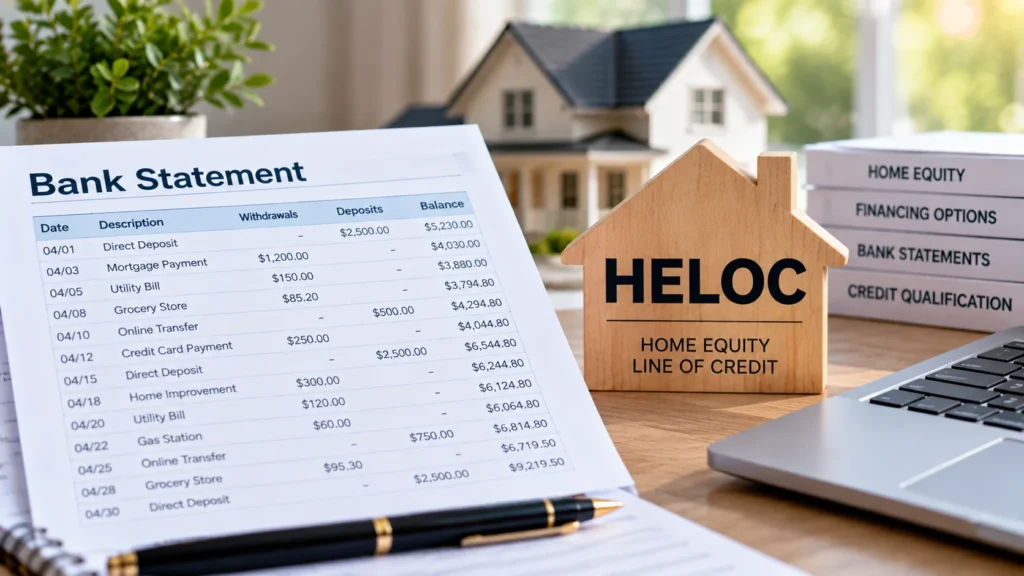
Requirements vary by lender and program. Credit, equity, income, property type, debt obligations, and account history can all affect eligibility.
Current HELOC guidance commonly considers credit score, debt-to-income ratio, equity, property value, and repayment capacity.
Credit Score
Credit requirements depend on the lender.
Many traditional HELOC lenders look for credit scores around the mid-600s or higher. Some bank statement programs may require stronger credit because alternative income documentation creates additional underwriting considerations.
A higher score can also affect the interest rate and available credit.
Home Equity
The amount of available equity is another major factor.
Lenders commonly calculate combined loan-to-value, or CLTV. This compares the existing mortgage and proposed HELOC balance with the home’s accepted value.
Some current programs advertise maximum CLTV levels between roughly 75% and 90%. These limits vary by lender, property, credit profile, and occupancy. (Finder)
Debt-To-Income Ratio
Debt-to-income ratio compares monthly debt obligations with qualifying income.
A lender can use its own DTI requirements when reviewing a bank statement HELOC. The income calculation can therefore have a direct effect on the borrower’s DTI.
Borrowers should ask whether the lender calculates income before or after applying business expenses.
Can You Get A HELOC Without Tax Returns?
Some bank statement HELOC programs are designed for borrowers who do not qualify using traditional tax-return income.
Instead of relying primarily on tax returns, the lender analyzes deposits shown in personal or business accounts.
However, this does not mean the borrower provides no financial documentation. Bank statements themselves become a major part of the underwriting process.
No Tax Returns Does Not Mean No Verification
The lender can still verify the property, credit history, existing mortgage, liabilities, deposits, and other financial information.
Some programs can also require proof of business ownership or self-employment.
Borrowers should therefore treat “no tax returns” as an income-documentation description rather than a promise of simplified approval.
Bank Statement HELOC Versus No-Doc HELOC
A bank statement HELOC is not necessarily a true no-documentation product.
Bank statements provide financial documentation. The lender uses those records to calculate income rather than depending entirely on traditional tax forms.
The term “no-doc” can also be used differently by different lenders. Applicants should review the actual documentation requirements before applying.
How Is Bank Statement Income Calculated?
Income calculation is one of the most important parts of a bank statement HELOC.
The lender reviews deposits and determines how much can reasonably be treated as income. Business borrowers may receive an additional expense adjustment.
Personal Bank Statement Calculation
With personal statements, the lender can review deposits entering the borrower’s account.
Certain transfers and non-income deposits may be excluded. The remaining eligible deposits can then be averaged across the required statement period.
The exact calculation depends on the lender’s underwriting policy.
Business Bank Statement Calculation
Business statements require additional analysis because deposits represent business revenue rather than personal earnings.
A lender may apply an expense ratio to account for operating costs. For example, it may treat only a percentage of eligible deposits as usable income.
The applicable percentage is lender-specific and should not be treated as a universal industry rule.
What Does A Bank Statement HELOC Cost?
Costs vary based on the lender, credit profile, property, loan amount, CLTV, and market conditions.
Bank statement programs can have higher interest rates than conventional HELOCs because they use alternative income documentation.
Interest Rates
Many HELOCs have variable interest rates.
The interest rate can change during the life of the line based on the applicable index and lender margin. Monthly payments can therefore increase when rates rise.
The CFPB recommends reviewing how the rate can change before opening a HELOC.
Fees And Closing Costs
Potential costs can include application fees, appraisal charges, title expenses, annual fees, and other lender charges.
Some HELOCs may also include early termination or account closure fees.
The CFPB recommends reviewing the fees and terms before accepting a home equity line.
What Is The HELOC Draw Period?
The draw period is the period when the borrower can access available funds.
For example, a HELOC agreement might allow borrowing for several years before entering repayment. The exact period depends on the lender.
Using Available Credit
During the draw period, the borrower can generally access funds up to the approved credit limit.
The borrower does not necessarily receive the entire approved amount at closing. Instead, money can generally be drawn when needed.
Interest is normally charged on the amount actually borrowed.
Repaying During The Draw Period
Payment requirements vary between HELOC agreements.
Some plans allow relatively low minimum payments during the draw period. Other plans can require principal and interest payments from the beginning.
Borrowers should review the payment formula before opening the line.
What Happens When The Draw Period Ends?
The HELOC eventually enters a repayment period.
During repayment, borrowers may no longer be able to draw additional funds. They must repay the outstanding balance according to the agreement.
Higher Monthly Payments
Payments can increase when the draw period ends.
This can happen because the repayment schedule requires principal to be paid over a shorter period. A borrower who made low payments during the draw period should prepare for this change.
The CFPB specifically warns that HELOC payments can increase substantially during repayment.
Can A Bank Statement HELOC Be A Second Mortgage?
Yes. Many HELOCs operate as second-lien financing behind an existing first mortgage.
This allows a homeowner to access equity without replacing the existing first mortgage.
Keeping The Existing Mortgage
A second-lien HELOC can be useful when the homeowner wants to keep the existing mortgage.
For example, a homeowner with a favorable first-mortgage rate may prefer accessing equity through a separate HELOC.
The lender still considers the existing mortgage when calculating CLTV and repayment capacity.
First-Lien HELOCs
Some lenders also offer first-position HELOC products.
A first-lien product can work differently because it occupies the primary lien position. Borrowers should compare the structure carefully before choosing between first- and second-lien options.
What Can You Use A Bank Statement HELOC For?
A HELOC can generally provide flexible access to funds for various personal purposes.
Common uses include home improvements, debt consolidation, education expenses, major purchases, emergency expenses, and certain business needs.
Home Improvements
Homeowners frequently use home equity financing for renovations and major repairs.
A HELOC can provide access to funds over time rather than requiring the homeowner to borrow the entire project budget immediately.
However, borrowers should consider interest costs and repayment obligations before using home equity.
Debt Consolidation
Some borrowers use HELOC proceeds to repay higher-interest debt.
This can change the structure of the debt but does not eliminate the underlying obligation. The homeowner is also putting the property at risk by using secured financing.
Borrowers should compare total costs rather than focusing only on the new interest rate.
What Are The Risks Of A Bank Statement HELOC?
The most important risk is that the HELOC is secured by the home.
Failure to make required payments can lead to serious consequences, including foreclosure in applicable circumstances.
Variable Interest Rates
Many HELOCs use variable rates.
If market rates rise, the interest charged on the outstanding balance can increase. This can result in higher monthly payments.
Borrowers should consider whether they could afford payments under a higher-rate scenario.
Reduced Access To Credit
A lender can sometimes freeze or reduce additional borrowing under specific circumstances.
The CFPB notes that a lender may restrict future draws if the home’s value falls significantly or the borrower’s financial situation changes.
Home As Collateral
Unlike unsecured personal credit, a HELOC uses the home as collateral.
This makes payment management especially important. Borrowers should understand the consequences of missed payments before using substantial amounts of their available equity.
What Consumer Protections Apply To HELOCs?
Federal rules provide specific disclosure requirements for home equity lines of credit.
Regulation Z contains rules covering home equity plans secured by a consumer’s dwelling. (Cornell Legal Information Institute)
Required Disclosures
Lenders generally provide information about important terms, costs, payment structures, and potential rate changes.
The disclosures help borrowers understand the financial obligations before completing the transaction.
Borrowers should review these documents rather than relying only on promotional descriptions.
Three-Day Cancellation Period
Certain HELOCs secured by a principal dwelling generally include a three-business-day right of rescission.
This right allows qualifying borrowers to cancel within the applicable period after opening the account or receiving the required disclosures, subject to federal requirements.
How Is A Bank Statement HELOC Different From A Home Equity Loan?
A HELOC provides revolving access to credit. A home equity loan generally provides a specific amount upfront.
A HELOC can therefore be useful when the borrower expects expenses to occur over time.
HELOC
A HELOC normally provides a credit limit rather than one lump-sum payment.
Borrowers can generally draw funds during the draw period. Interest applies to the outstanding balance according to the agreement.
Home Equity Loan
A home equity loan generally provides a predetermined amount.
The borrower receives the funds upfront and makes payments under the loan’s repayment schedule.
The appropriate product depends on the borrower’s funding needs, repayment preferences, and financial circumstances.
How Is A Bank Statement HELOC Different From A Bank Statement Mortgage?
These products use similar income-documentation concepts but serve different purposes.
A bank statement mortgage can finance the purchase or refinancing of property. A bank statement HELOC provides a revolving line against existing home equity.
Bank Statement Mortgage
A bank statement mortgage uses deposits to evaluate income when traditional income documentation may not provide a suitable picture.
It can be used by certain self-employed borrowers who meet the lender’s other requirements.
Bank Statement HELOC
A bank statement HELOC uses similar deposit-based income verification.
However, the borrower already owns the property and is seeking access to available equity.
The property secures the HELOC, just as home equity generally secures conventional HELOC financing.
How Do You Apply For A Bank Statement HELOC?
The application process begins with selecting a lender that offers bank statement qualification.
Borrowers should compare documentation requirements, credit standards, CLTV limits, rates, fees, and repayment terms.
Gather Financial Documents
Depending on the program, borrowers may need:
- 12 or 24 months of bank statements
- Identification documents
- Mortgage information
- Property insurance information
- Proof of self-employment
- Business documentation
- Information about existing debts
- Property valuation information
The lender determines the final documentation requirements.
Review The Property
The lender needs to establish the property’s value and existing liens.
An appraisal or alternative valuation method may be required. The resulting value affects the maximum available HELOC amount.
Existing mortgage balances are also considered when calculating available equity.
Compare The Loan Terms
Borrowers should compare more than the advertised interest rate.
Review the margin, draw period, repayment period, fees, minimum payments, rate caps, conversion options, and early closure requirements.
These terms can have a significant effect on the total cost of borrowing.
Is A Bank Statement HELOC Right For Everyone?
No. Bank statement HELOCs are designed for a specific type of borrower.
They can be useful when traditional income documentation does not accurately reflect cash flow. A conventional HELOC may be simpler for borrowers with straightforward W-2 income.
When It May Make Sense
A bank statement program may be worth considering when the borrower has substantial documented deposits but lower taxable income.
It can also be relevant when business income is irregular but supported by a consistent financial history.
When Another Option May Work Better
Borrowers with strong W-2 income may qualify through conventional HELOC programs.
A home equity loan may also make more sense when the borrower needs one fixed amount instead of revolving access.
Comparing multiple products can help identify the structure that fits the borrower’s financial needs.
Why Accurate Information Matters When Researching Banks
Financial searches can sometimes combine unrelated topics because many banking terms have multiple meanings.
For example, a search for a Deerwood Bank routing number concerns payment processing information for a specific Minnesota bank.
By contrast, a search for 155 Bank Street NYC concerns a Manhattan address associated with Westbeth Artists Housing.
These examples show why the exact context matters when researching financial terminology, addresses, and banking services.
The same principle applies to HELOC research. A bank statement requirement can differ substantially between lenders, so borrowers should verify current program terms.
Frequently Asked Questions
What Is A Bank Statement HELOC?
A bank statement HELOC is a home equity line that uses bank deposit history to evaluate income. It is commonly marketed toward self-employed borrowers and business owners.
How Many Bank Statements Are Needed For A HELOC?
Many specialized programs request 12 or 24 months of statements. The exact requirement depends on the lender and the borrower’s circumstances.
Can I Get A HELOC Without Tax Returns?
Some bank statement programs allow borrowers to qualify without traditional tax-return income documentation. However, the lender still requires financial verification and underwriting.
What Credit Score Is Needed For A Bank Statement HELOC?
There is no universal minimum. Requirements vary by lender, but many HELOC programs consider credit scores in the 600s or higher.
Can Self-Employed People Get A HELOC?
Yes. Self-employed borrowers are one of the main groups targeted by bank statement HELOC programs.
Do Bank Statement HELOCs Have Higher Rates?
They can. Bank statement programs may carry higher rates than conventional full-documentation HELOCs, although pricing varies by lender and borrower.
Can A HELOC Be Used For Business Expenses?
Some borrowers use home equity proceeds for business purposes. However, borrowers should confirm the lender’s permitted-use rules and understand that the home secures the credit line.
Does A HELOC Affect Your Existing Mortgage?
A second-lien HELOC can allow the existing first mortgage to remain in place. The HELOC lender still considers the first mortgage when calculating the borrower’s combined loan-to-value ratio.
Is A Bank Statement HELOC The Same As A No-Doc HELOC?
No. Bank statement HELOCs still require financial documentation through bank statements. The term no-doc can describe different products and should be verified with the lender.
Final Takeaways
A bank statement HELOC uses bank deposits to evaluate income for a home equity line of credit. It can provide another financing option for homeowners with nontraditional income.
Self-employed borrowers and business owners are common users because tax returns may not fully reflect their business cash flow.
Most specialized programs still examine credit, equity, property value, debt obligations, and repayment ability. Bank statements provide income evidence but do not eliminate underwriting.
Borrowers should compare statement requirements, income calculations, CLTV limits, rates, fees, draw periods, repayment terms, and lender restrictions.
Because the home secures the HELOC, borrowers should also understand the consequences of missed payments and rising interest rates.
The most important step is verifying the lender’s current requirements before applying. Bank statement HELOC programs vary, so no single credit score, statement period, rate, or CLTV applies to every borrower.